Magic systems in fantasy have a funny habit of exposing lazy storytelling. If your wizard can suddenly solve every problem with a spell nobody knew existed five minutes ago, something has gone terribly wrong. The best magic systems give characters extraordinary powers but make them work for it. And that’s where the fun begins.
A magic system is the set of rules, sources, abilities and limitations that determine how supernatural forces work in a fictional world. It defines who can use magic, what they can accomplish and what consequences come with using it.
Here’s the paradox at the heart of magic systems in fantasy: the more power you give your characters, the more carefully you need to consider its limitations. The most fascinating magic isn’t what a wizard can do, but what they’re desperately forbidden from doing.
Get the magic system right, and magic becomes one of the most compelling forces in your fictional world. The rules need internal logic, consequences and the occasional delightful oddity. Let’s break down the different approaches authors can take and how to build a magic system that gives your story room to grow.
I’m Claire, by the way. I wrote this little guest piece for Quibble and hope you enjoy it.
What Are Magic Systems?
Think of it as the physics of your fantasy universe. In our world, gravity doesn’t take a holiday. In a fantasy world, magic shouldn’t behave differently simply because the author needs a convenient plot twist.
Magic systems determine:
- The source of magic: Where does magical power come from? Nature, gods, ancient artefacts, bloodlines, or something altogether stranger?
- Who can use it: Is magic accessible to everyone, reserved for a chosen few, or something people must sacrifice to obtain?
- How it works: Does it require spells, rituals, physical gestures, knowledge, emotions or specific materials?
- Its limitations: What prevents magic users from becoming effectively omnipotent?
- Its consequences: Does using magic cause physical exhaustion, consume memories, attract dangerous entities or distort reality?
Together, these elements give magic systems in fantasy their internal logic, shaping everything from character development to political structures, religion and warfare.
Different Types of Magic in Fantasy
Magic systems in fantasy come in all shapes and forms. Here are some common approaches, along with what makes each interesting.
1. Elemental Magic
Elemental magic draws power from natural forces such as fire, water, earth, air, lightning or ice. It’s one of the most recognisable approaches in fantasy, partly because its possibilities are immediately intuitive. Readers understand what fire does.
The interesting question is what your characters can do with it. Perhaps fire magic requires oxygen, water magic becomes stronger near oceans, or earth magic allows practitioners to manipulate minerals.
The trick is to move beyond the obvious. An elemental mage who controls the humidity inside someone’s lungs is considerably more unsettling than another character throwing fireballs.
2. Arcane and Spell-Based Magic
Here, magic is practised through learned knowledge, spoken incantations, symbols, gestures or carefully constructed rituals. Think ancient libraries, forbidden grimoires and scholars who spend decades studying the underlying principles of reality.
This approach works particularly well when magical knowledge is unevenly distributed. Perhaps universities control access to certain spells, religious institutions suppress particular schools of magic, or a handful of scholars understand something the ruling class desperately wants to keep secret. Knowledge becomes power. Quite literally.
3. Divine and Spiritual Magic
In these systems, magic comes from gods, spirits, ancestors or other supernatural entities. Characters might receive their abilities through devotion, bargains, blessings or divine intervention.
But here’s where things get interesting: what happens when the gods disagree? A priest might lose their abilities after questioning their deity. Another might discover that the entity they’ve worshipped for decades is actually something far more sinister.
Divine magic creates excellent opportunities for exploring faith, morality and the relationship between power and authority.
4. Bloodline and Inherited Magic
Some worlds make magical ability hereditary. Certain families, species or bloodlines possess abilities unavailable to everyone else. This can create fascinating social structures. Magical families might become aristocratic dynasties, while those without abilities are treated as second-class citizens.
But inherited magic also raises an important question: what happens when someone breaks the pattern? Imagine a child born into a powerful magical dynasty who possesses no abilities whatsoever. Or someone from an ordinary family who manifests an ancient, supposedly extinct power.
5. Wild and Unpredictable Magic
Some magic is deliberately mysterious, ancient and capricious. It might emerge from forgotten places, strange celestial events, mythical creatures or forces that humans cannot fully comprehend.
I personally particularly enjoy this approach when the story benefits from a sense of wonder. Perhaps a forest rearranges itself depending on who enters. Perhaps certain stars whisper to people born during eclipses. Magic is simply something the world does, rather than something humans control.
But be careful here: the less predictable the magic, the more important it becomes to establish its narrative boundaries.
Hard Magic vs. Soft Magic: How Much Should Readers Know?
I’ll confess: I’m terribly susceptible to a bit of magical mumbo-jumbo. Give me a suspiciously glowing artefact and I’m happy. I don’t need a meticulous explanation of every supernatural shenanigan. But, some readers are rather perspicacious and want a technical explanation for everything. This brings us to an interesting distinction: hard magic versus soft magic.
Hard magic systems leave relatively little to guesswork. Their rules are established, and readers get a decent understanding of what magic can and cannot do. Think of it as learning the rules of a particularly peculiar game. Once you know how it works, you can start spotting clever ways characters might bend those rules to their advantage.
Soft magic systems operate with fewer explicitly defined rules. Their workings may remain mysterious, even to the characters using them. This approach creates atmosphere, wonder and a sense that the universe contains forces beyond human understanding.
Neither is inherently better. However, I’d be careful about confusing mystery with inconsistency. Readers don’t necessarily need to understand every magical mechanism, but they should feel that the author does.
One of the defining choices when designing magic systems in fantasy is deciding how much of their underlying logic readers should understand.
How to Create Magic Systems: A Practical Guide for Authors
Creating magic systems in fantasy that feel original takes more than inventing a few clever spells.
1. Decide What Magic Means in Your World
Before inventing spells, consider the role magic plays in everyday life. Is it commonplace or extraordinarily rare? Is it feared, celebrated, regulated or worshipped?
Imagine two kingdoms. In the first, magic is accessible to almost everyone. Farmers use it to improve harvests and merchants employ minor enchantments to protect their goods. In the second, magic is restricted to a handful of aristocratic families.
These worlds will develop very differently. Their economies, institutions, conflicts and social hierarchies will reflect the magical systems underpinning them.
2. Establish the Source of Power
Where does magic originate? Don’t settle for “ancient energy” unless you have a more interesting idea behind it.
Perhaps magic comes from memories. Practitioners sacrifice their happiest experiences to perform increasingly powerful spells. Perhaps it originates from mythical creatures, and harvesting their abilities has created an entire black market.
The source of magic should give your world its own identity. A distinctive origin also provides opportunities for conflict and exploitation.
3. Define the Rules and Limitations
This is where many authors come unstuck. If magic can solve every problem, why should your characters struggle with anything? Strong magic systems in fantasy use limitations to force difficult choices and keep characters from becoming too powerful.
Consider introducing:
- Physical costs: Magic exhausts the user, damages their body or shortens their lifespan.
- Material requirements: Powerful spells require rare ingredients, enchanted objects or specific environments.
- Knowledge barriers: Certain abilities demand years of training or knowledge that has been deliberately suppressed.
- Moral consequences: Using magic might harm another person, disturb the natural world or violate an ancient prohibition.
The most compelling limitations create dilemmas. A character who can save an entire village by sacrificing one precious memory has a much more interesting decision to make than someone who needs to recharge their mana (yes, I’m looking at you, video game wizards.
4. Connect Magic to Your Characters
Consider how your system shapes individual personalities. I personally find this aspect central to incredible magic systems. After all, what’s the point of giving someone extraordinary powers if they’re going to have the personality of a damp sock?
A character whose magic grows stronger through emotional vulnerability might struggle with intimacy. A practitioner who must steal memories to cast spells might gradually lose their sense of identity.
In my experience, this is where magic stops being a collection of cool abilities and starts becoming storytelling. I really love this.
5. Let the World Reveal Its Magic
Readers enjoy discovering magical concepts through action, dialogue and environmental details. Show a merchant checking whether a coin has been enchanted. These small details make magic feel embedded in everyday life. This too is incredible storytelling.
A seemingly insignificant custom might turn out to have an extraordinary magical purpose. That’s a lovely little trick.
Common Mistakes When Writing Magic in Fantasy Novels
A few pitfalls are worth watching.
Making magic too powerful. If characters can teleport anywhere, resurrect the dead and defeat any opponent, your story loses much of its tension. Power needs boundaries.
Explaining absolutely everything. A detailed explanation of every incantation can turn an exciting fantasy adventure into a technical manual. Leave some lacunae for readers to fill.
The conveniently timed superpower. If your protagonist suddenly discovers they can do something extraordinary every time they’re in trouble, readers will start getting suspicious. At some point, even magic needs to stop bailing you out.
Ignoring the consequences. Magic should change the world. The ability to teleport would transform transportation, while widespread healing magic would fundamentally reshape medicine. Communication over vast distances could alter politics and warfare. And if dragons exist, someone needs to figure out what they eat, who hunts them and whether they’re intelligent. The little questions often lead to memorable world-building.
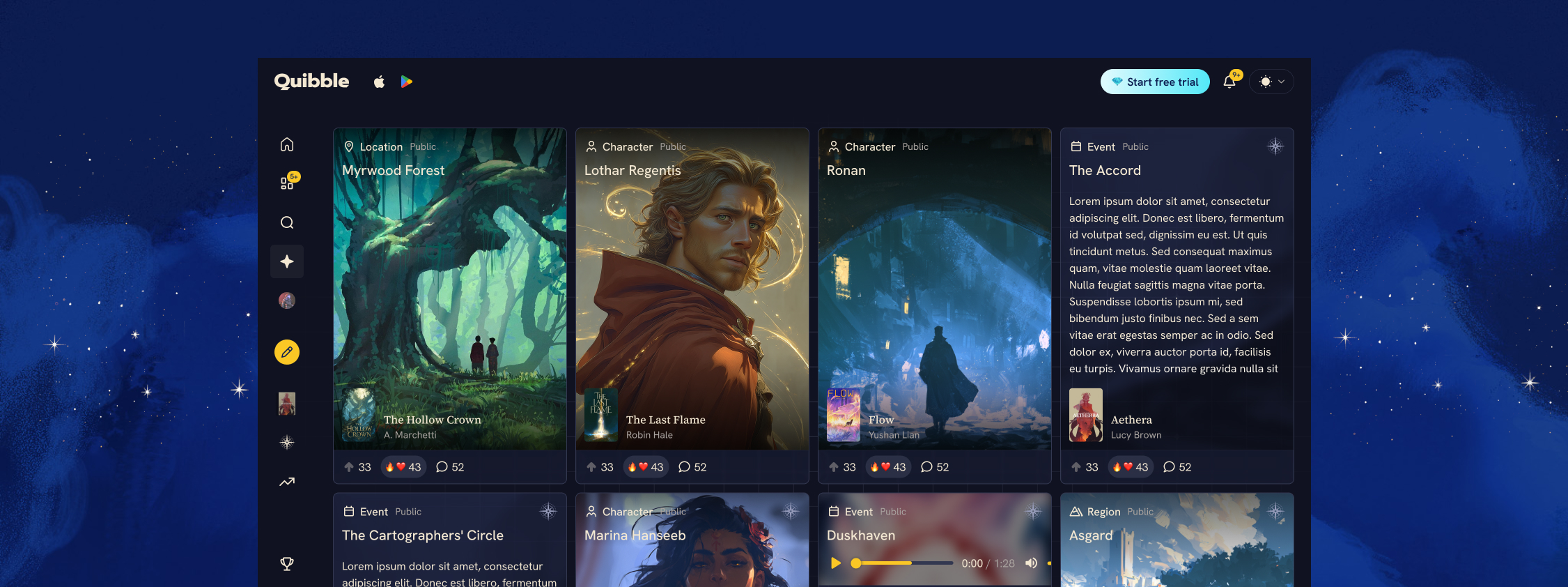
Build Your Magical World on Quibble
If you’re developing your own system, publish your story and build your world on Quibble! The Quibble community is getting more vibrant by the day, and there are plenty of fellow world-builders around who will happily disappear down a rabbit hole about your fictional pantheon.
You can also join Quibble on Discord to exchange ideas and connect with other magic builders. Bring your spellbooks.
If you’re looking for a creative challenge, Quibble runs monthly writing contests! Write a short story or flash-fiction piece of up to 2,000 words and compete for some rather cool prizes.
Finally, explore current writing contests and enter here. Who knows? Your next writing project might just become someone’s favorite fictional universe.