The future of book publishing looks rather different from what most authors imagined a few years ago. AI is changing how stories are created and readers have more fiction at their fingertips than ever before. What does this mean for writers? And more importantly, how can authors earn from writing in the future?
I think we’re approaching a really interesting period. Not the death of traditional publishing or old school writing, as some would have you believe, but a fundamental change in how stories are created, distributed, discovered, celebrated, judged and monetized. I actually find what’s coming next incredibly exciting.
The Book Publishing Industry Continues to Evolve
For decades, the publishing industry operated around a fairly straightforward arrangement. Write a manuscript. Find an agent. Convince a publisher. Wait for months (or years). Hope the marketing department remembers your book exists.
Traditional publishing will always have its place. Pundits predicted its demise 20 years ago (and they are doing it again today). They were wrong and will be wrong again.
Self-publishing via Amazon KDP has changed the industry. You already know that; digital distribution allows authors to reach international audiences without negotiating with publishers, printing thousands of copies and securing shelf space at a bookstore.
The next generation of digital publishing platforms after Kindle - Wattpad, Inkitt, Webnovel, Royal Road, and others - took self-publishing further. Instead of treating a book as a finished product, these platforms allow authors to publish chapter by chapter, interact with readers and build an audience while writing.
Each technological upheaval has precipitated a new publishing paradigm, and AI may well prove the most consequential inflection point yet. But what will it look like?
Serial Publishing Will Become a Much Bigger Part of the Industry
First, I suspect we’ll see more authors treating their stories as ongoing creative projects. As AI makes the production of finished manuscripts increasingly facile, the value of publishing shifts from the artefact itself to the ongoing relationship between creator and audience.
The concept isn’t new. Charles Dickens published many of his novels in installments long before anyone had invented the Kindle. Readers would eagerly await the next installment and speculate about what might happen next.
AI will make it increasingly difficult to distinguish promising work. Polished manuscripts will become abundant. Serial publishing shifts the proof of value from prediction to demonstrated reader interest, making audience validation far more consequential than before. Serial fiction invites participation, and that ongoing engagement creates something AI cannot manufacture.
Competition Will Increase
We can’t discuss the future of book publishing without discussing AI in depth. Tools for brainstorming, editing, proofreading, translation and research are already changing the writing process. Some authors use them extensively, others prefer to keep them at arm’s length.
AI is reducing the cost and effort involved in producing certain types of content. This means more people can experiment with writing and develop stories in virtually any language. But it also means much more content will compete for readers’ attention.
I wouldn’t get too caught up in the argument that every author must prove their writing is human-made. Of course, authenticity matters to some readers. But the online debate sometimes makes it sound as though everyone is desperately investigating the origins of every paragraph they read. In reality, many readers care considerably more about whether a story is entertaining than which tools helped produce it.
AI-assisted writing isn’t automatically good or bad. A poorly written novel doesn’t become entertaining simply because a human typed every word. The real challenge for authors will be differentiation. And that brings me to where we believe publishing evolves next.
Authors Will Need to Give Readers More Than Words
Here’s my prediction: in the coming years, successful authors will increasingly behave like creators, not just writers.
Think about it. Before the AI boom, your story competed with 10 other stories, now it competes with… 100? Maybe 500? So, why should readers follow your story rather than the hundreds of other fantasy novels published around the same time? What can you do as an author, provided the AI boom doesn’t affect your passion for creating and sharing stories?
Simple answer: create new experiences around your stories. For example:
- Show up in the comments. Discuss readers’ theories and answer their questions. You can already do that on existing platforms - now you might just have to do more of it.
- Create polls. Let readers speculate about upcoming developments, vote on their favourite characters or share opinions about particular storylines. The more often you invite them to contribute, the more likely they will start to follow you.
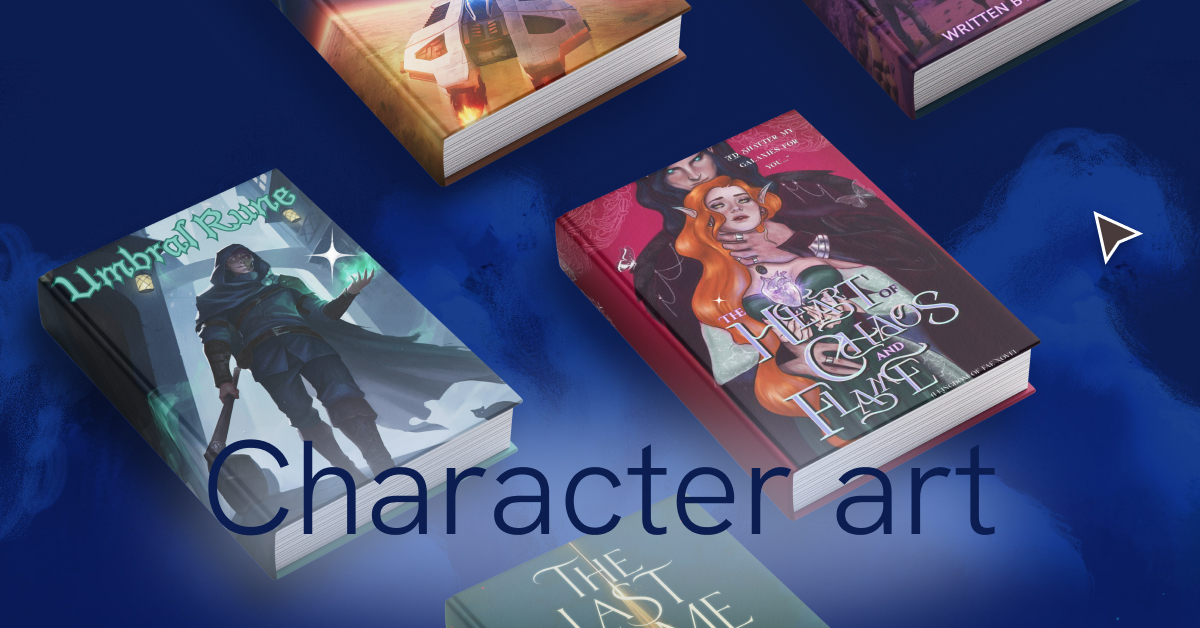
- Create character art. Give readers a visual representation of the characters they’ve grown attached to. I’ve written more about this in our guide to creating character art for books.
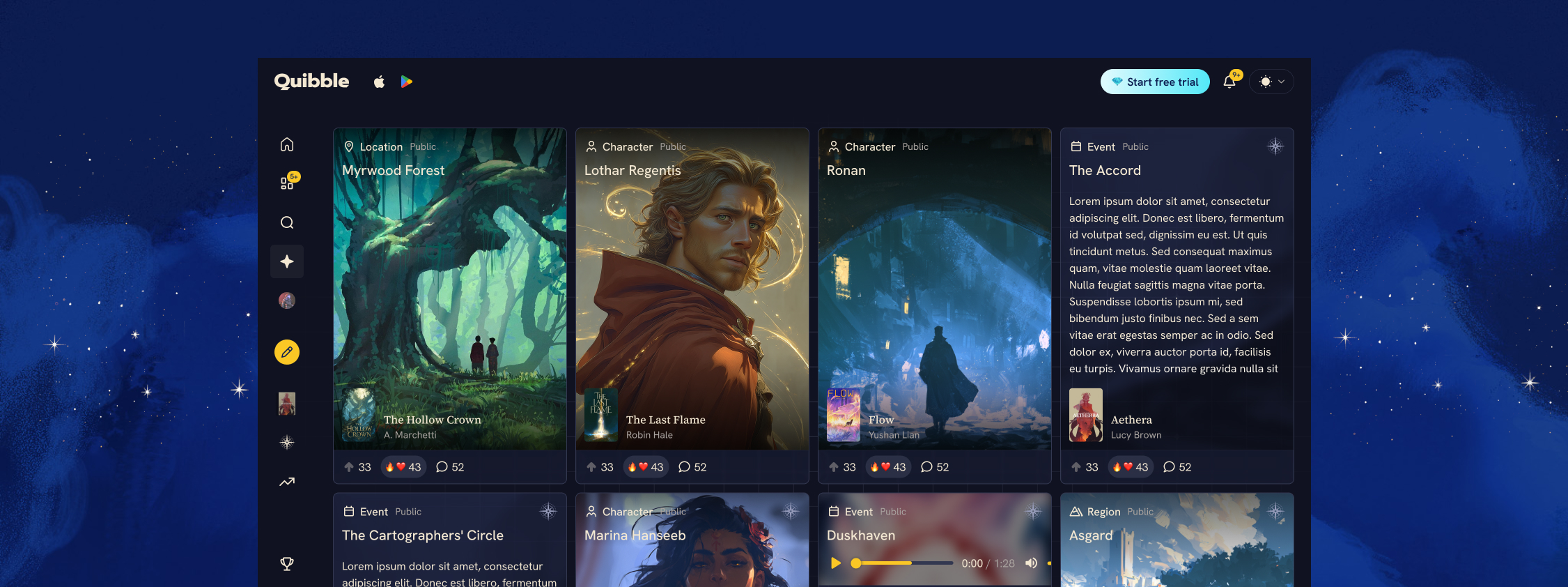
- Make collectibles. Character profiles, maps, faction emblems and illustrations can become additional discoveries within a fictional universe. Think of them as little rewards for readers who want to explore further.
- Share your creative process. Short videos from your favorite writing café.
None of this means authors should become full-time social media entertainers. Please, no reader needs another TikTok dance. But I do think the authors who understand how to build an experience around their fiction will have an advantage.
How to Earn Money from Writing in 2027
Let’s get to the question most serious authors eventually ask: how do you actually earn from writing in this future?
Before answering that, let’s review how you can earn money today. There are several established options, but they come with different economics and trade-offs.
Amazon KDP: The Established Self-Publishing Route
Amazon Kindle Direct Publishing remains “the most likely” path to monetize finished books. KDP offers royalty options of 35% and 70%, subject to pricing, territory and other conditions. There is also KDP Select, which allows authors to earn from Kindle Unlimited reading activity through a share of Amazon’s monthly fund.
But, there’s an important catch: enrolling an ebook in KDP Select requires digital exclusivity to Amazon during each 90-day enrollment period. That means you cannot distribute the same ebook elsewhere while it’s enrolled, which is kinda… meh. Only you know whether that’s a good deal for you. The good news is that if it doesn’t work out for you, you can cancel quarterly and explore other options.
Wattpad and co: Different Limitations
The next option is publishing on fiction platforms. Each platform comes with its own trade offs.
Wattpad offers opportunities through its Creators Program and Wattpad Originals. These opportunities are not available to everyone. Access depends on meeting specific eligibility criteria, demonstrating audience traction and being selected or invited by Wattpad.
Inkitt offers an Author Subscription Program, allowing writers to create subscription tiers. Unlike Webnovel, readers cannot purchase individual chapters as standalone transactions. Chapter-level purchases offer readers greater autonomy, sparing them the subscription fatigue of accumulating recurring charges for services they may eventually forget they subscribed to.
Royal Road doesn’t offer native monetization, so authors typically direct paying readers to external services such as Patreon, where they offer subscription tiers (similar to Inkitt). This means readers must leave Royal Road, create another account and manage a separate subscription. The arrangement creates a degree of fragmentation between discovery, reading and monetization that is anachronistic in an interconnected publishing ecosystem.
WebNovel offers contracted author opportunities and monetization directly through its platform including chapter-by-chapter. These opportunities come with exclusivity strings attached and require authors to meet certain eligibility criteria. Authors should pay particular attention to the terms governing rights, exclusivity and distribution restrictions.
These platforms have enabled countless talented authors to build sustainable writing careers, but AI introduces a new asymmetry: fiction is becoming abundant, while reader attention remains finite. In an increasingly crowded marketplace, authors need to monetise demand as it emerges, not after clearing arbitrary thresholds or relinquishing distribution rights. Chapter-level purchases offer the granularity and commercial latitude this new reality demands.
The Future of Book Publishing
If a platform expects an author to surrender distribution rights, it should offer something commensurate in return: meaningful advances, guaranteed income, substantial marketing support, professional development or demonstrably superior distribution.
As a result, digital publishing stands at the threshold of another paradigm shift, one that must place greater creative autonomy, commercial agency and economic opportunity in the hands of authors.
No Exclusivity. No Thresholds. No Gatekeeping.
The starting point for the next generation of digital publishing should be a simple principle: authors should be free to publish wherever they want and earn from their work whenever they want.
No exclusivity agreements, minimum follower counts, engagement thresholds, or invitation-only monetization programs. Instead, frictionless, chapter-level monetization gives creators an immediate, incremental signal that their work is worth pursuing: every unlock is both a small commercial reward and an affirmation to keep going. As readership converts into revenue, authors gain the confidence to invest further in their worlds, from character art to richer storytelling and new formats.
Subscription models and eligibility-based programs simply cannot offer the same granularity of feedback or the same organic, self-reinforcing creative flywheel.
Our new author monetization system is nearing completion, with final testing now underway. Designed for a global creator economy, it will support payouts in all major currencies, removing unnecessary pecuniary barriers between authors and their readers.
The rollout is only days away. Those eager to be among the first authors earning on Quibble should keep an eye on our Discord community, where we’ll unveil the system before anywhere else.
The Format Is Going to Evolve as Well
But flexibility in monetisation is only the beginning. The future of book publishing is also about who controls the creative decisions.
As AI makes written content increasingly ubiquitous, the question facing authors is no longer merely how to monetise a book, but what a book can become. When prose is abundant, the ability to offer readers something beyond prose becomes an increasingly potent differentiator.
The most ambitious writers will evolve into something closer to creative directors: building worlds that extend beyond the written word through character art, illustrations, music, collectibles, interactive experiences and, eventually, entirely new formats.
Others will collaborate with artists and other creative talent, assembling an imaginative collège around their work rather than attempting to master every discipline themselves.
This is the next publishing paradigm: dismantling the constraints of the book as a self-contained artefact. The authors who distinguish themselves will be those who turn their stories into something more syncretic and difficult to replicate.
Consider a fantasy series. A reader might start with a conventional novel, discover character illustrations along the way, explore a map of the fictional world, listen to its soundtrack carefully chosen by the author and eventually follow a companion story from another character’s perspective.
That’s a rather exciting prospect. And if you’re wondering how all of this might come to pass, you’ve come to the right place.
The Future of Book Publishing
So, what does the future of book publishing actually look like in 2027? If I had to make a few publishing predictions for 2027, I’d focus on three developments.
First, distribution will become less important than discovery. Authors will need to become more assiduous about building an audience and maintaining relationships with their readers.
Second, monetization will become more flexible. Authors will increasingly expect to earn directly from individual chapters and world-building content, rather than relying on finished-book sales or invitation-only programs.
Third, fictional worlds will become more valuable than individual formats. The authors who develop compelling characters, settings and stories - and put art behind them - will have more opportunities to grow their work into something larger.
Of course, the road ahead will be rife with vicissitudes. But that, after all, is the very nature of prediction.